Two Voices, One Body: A Fan-Based Hulk Comic
1. A Monster in Hiding
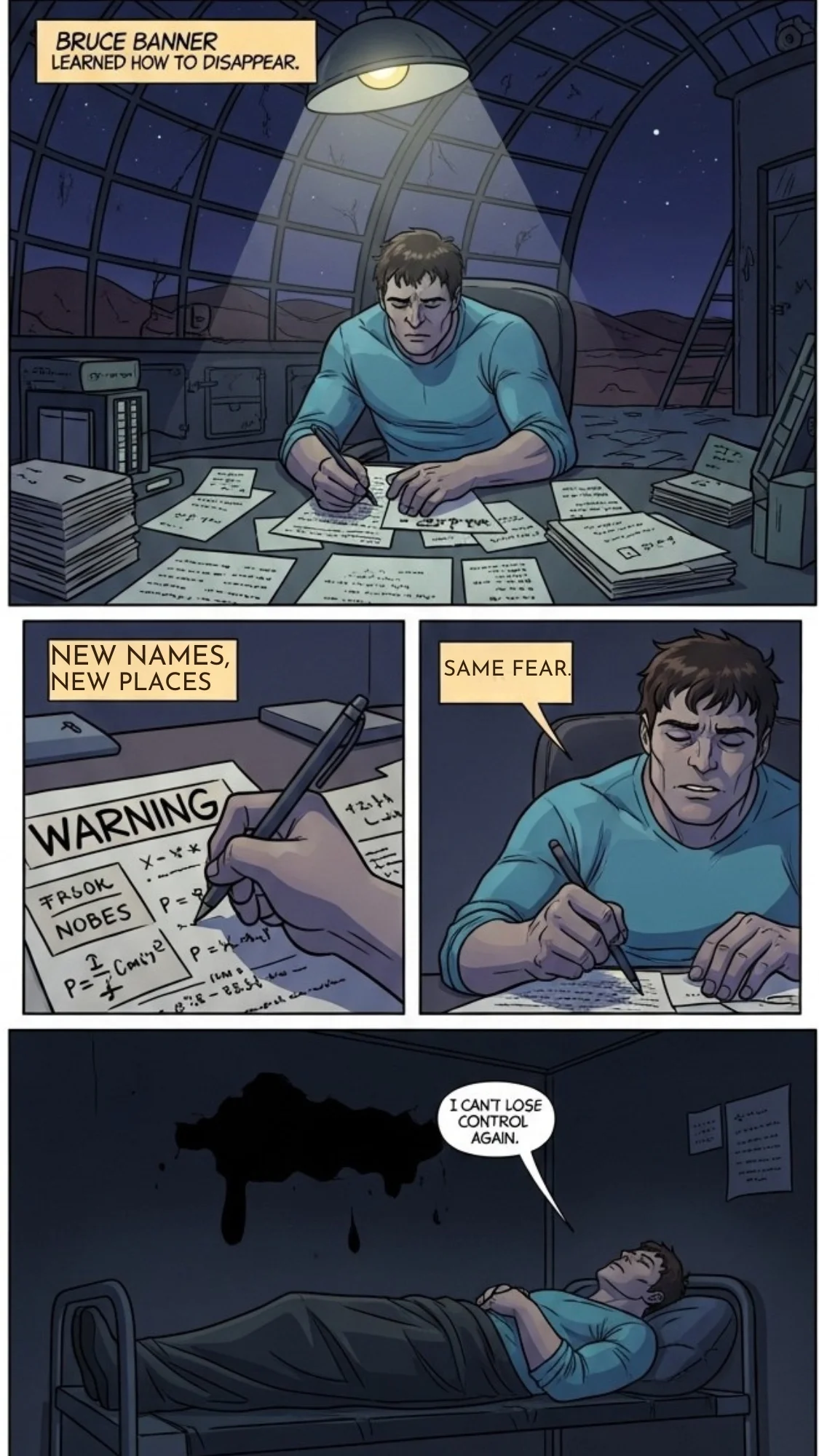
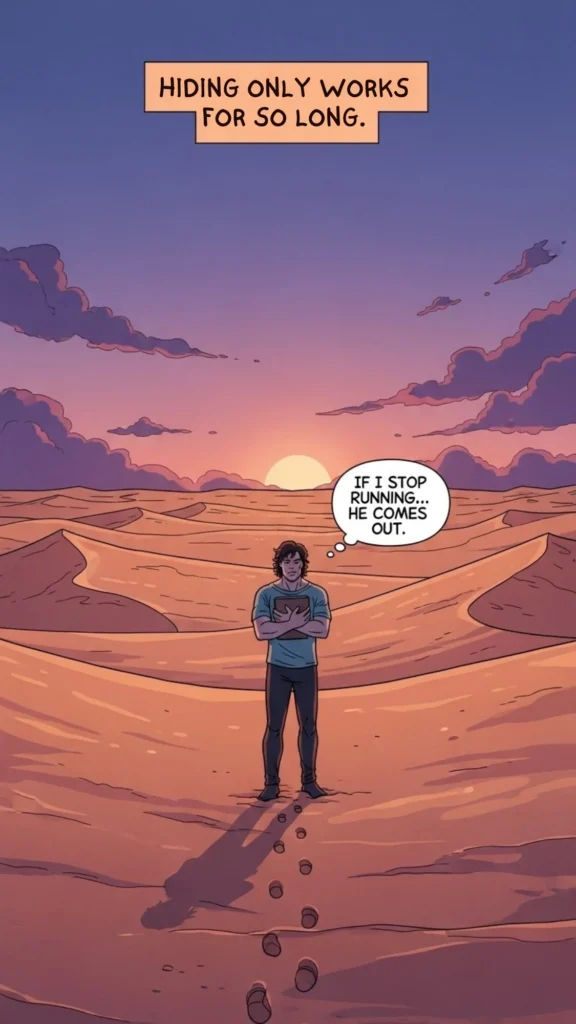
Bruce Banner knows how to disappear now.
Not in some flashy, superhero way—no vanishing acts, no smoke bombs, no epic goodbyes. The way he does it is quieter, almost invisible. He slips away like someone who’s been hurt too many times: carefully, methodically, making sure he leaves barely a trace. New towns, fake names, borrowed labs that he abandons as soon as he can. Nights spent wide awake, listening to his own breathing, counting out the seconds between heartbeats, hoping—praying—that nothing in that rhythm goes wrong.
Because if it does, the other guy wakes up.
The world remembers Hulk as pure destruction—cities smashed to rubble, tanks tossed aside, soldiers running for their lives. Clips of him in full rage loop online, always out of context, always stoking fear. To most people, Hulk is a disaster you can’t contain. To governments, he’s a walking breach of security—an experiment that broke loose.
But Bruce? For him, Hulk is something worse.
He’s close. Too close.
Right now, Bruce is hiding out in an old weather station, half-collapsed and rusted, forgotten on the edge of nowhere. It’s far from anything—no one around, nothing to tempt the military, just empty desert for miles. Bruce has figured out that being alone is the only real kindness he can offer the world.
Inside, the place is bare. There’s a folding cot, a small generator, scraps of notes taped to the walls—equations, breathing routines, reminders scrawled in a shaky hand.
STAY CALM.
DO NOT PANIC.
ANGER IS A TRIGGER.
FEAR IS A TRIGGER.
And yeah, he gets the irony. Even fear is dangerous now.
Most days, Bruce buries himself in research nobody will ever see. It gives him something steady to focus on—logic holding back the flood of panic. But when the sun goes down and the wind rattles the walls, the thoughts he’s been holding off start slipping in.
You can’t keep this up forever.
That thought doesn’t sound like him.
At first, he blames stress, or maybe he’s just losing it. He’s run through every psychological checklist before—his mind is always a lab, even while it’s falling apart. But this is new. The voice isn’t loud, doesn’t shout.
It waits.
Then, little things start to shift. Bruises show up on his arms, and he can’t remember how he got them. He spots huge footprints outside the station—definitely not his. One morning the busted generator is humming along, fixed in a way only someone impossibly strong could manage.
That night, Bruce writes in his journal:
Memory gaps increasing. Duration unknown. Hulk activity suspected.
His hand shakes as he adds another line, one he never thought he’d write:
Behavior appears purposeful.
The next time, there’s no doubt.
A dust storm barrels in, faster and meaner than the forecast said. Bruce feels it—the pressure building, the warning signs, the chemical surge he can’t stop. He drops everything and hits the ground, digging his fingers into the sand, counting desperate breaths.
He loses time.
When he comes back, the storm’s gone. Sky’s clear. The station is still standing, protected by a rough wall of debris—metal, rocks, whatever was lying around—stacked up with a kind of brutal care. Only hands that could bend steel would’ve managed it.
Bruce just stares, heart pounding.
Hulk didn’t just break out.
Hulk stayed.
That night, Bruce lies on the cot and stares at the ceiling, finally letting in the truth he’s dodged for years.
Hulk isn’t just reacting anymore.
He’s thinking.
And somewhere deep inside the mess of Bruce’s mind, something else is awake—watchful, waiting, and very much alive.
2. The Incident That Breaks the Silence

Bruce Banner has always trusted in patterns.
Patterns make sense. They don’t lie. If you can figure out enough of the variables, chaos starts to reveal its edges. That idea kept him going through years of running, hiding, calculating—clinging to the hope that the Hulk was a puzzle he could solve, not a life sentence.
The desert shatters that hope.
Three days after the storm, Bruce picks up a scrambled radio signal while he’s tuning a battered old antenna. At first, it’s just static—chopped-up words, clipped orders, panic leaking through discipline. He almost ignores it. Almost.
But then, coordinates come through.
They’re close. Way too close.
Bruce kills the generator on reflex, hands moving before he even thinks. No power means no signal, no heat signature—nothing to draw attention to this forgotten weather station in nowhere. Still, his heart thunders in his chest, all wires and panic.
He knows what that kind of transmission means.
Someone’s coming.
Through a pair of cracked binoculars, Bruce catches sight of them by dusk: black, unmarked vehicles crawling over the ridge, slow and careful. Not soldiers—at least, not officially. These teams never are. They move like people who’ve practiced this exact moment, convinced they’ve finally cornered their monster.
Bruce grabs only what matters. Journal. Data drive. Sedatives—though he knows they’ll do nothing if things go wrong. He tells himself he has time, that he’ll slip away under cover of darkness, just like always.
Then—pressure in his skull, sudden and sharp.
Why are you running?
Bruce freezes.
The voice is clearer now. Not some vague echo, not his imagination. It’s deep, coiled, alive somewhere underneath thought.
He whispers into the empty room, “Because if I don’t… you come out.”
Silence.
They already came for us.
That word—us—hits harder than any threat.
Outside, engines die. Doors swing open. Boots crunch on sand.
Bruce barely makes it five steps before a spotlight splits the night. A voice blasts from a megaphone—too calm, too rehearsed, almost polite.
“Bruce Banner. You are requested to surrender peacefully.”
Requested.
Bruce laughs, once—hollow, rough. His heart’s already pounding. His body knows what’s coming before his mind can accept it. This time, the change doesn’t start with rage. It starts with fear—raw, chemical certainty.
His vision blurs. The ground suddenly feels too small beneath him.
Let me handle this, the voice says.
“No,” Bruce gasps. “You’ll kill them.”
They will kill you.
A warning shot snaps through the air, kicking up sand at his feet. That’s it. Not anger, not pride—just survival.
Bruce doesn’t feel his bones break.
He feels them shift.
Muscle surges like a tidal wave. Skin tightens, stretches, darkens. The world lurches as he grows. Pain is there, but it’s just data—something to process and discard.
The Hulk stands where Bruce Banner stood.
Spotlights stutter, struggling to keep up. Someone starts barking orders. Guns rise.
But Hulk doesn’t charge.
He just looks at them.
Really looks.
The soldiers tense, bracing for the violence they’ve been taught to expect. It doesn’t come. Hulk steps back, putting himself between the station and the advancing team. His shadow swallows their lights.
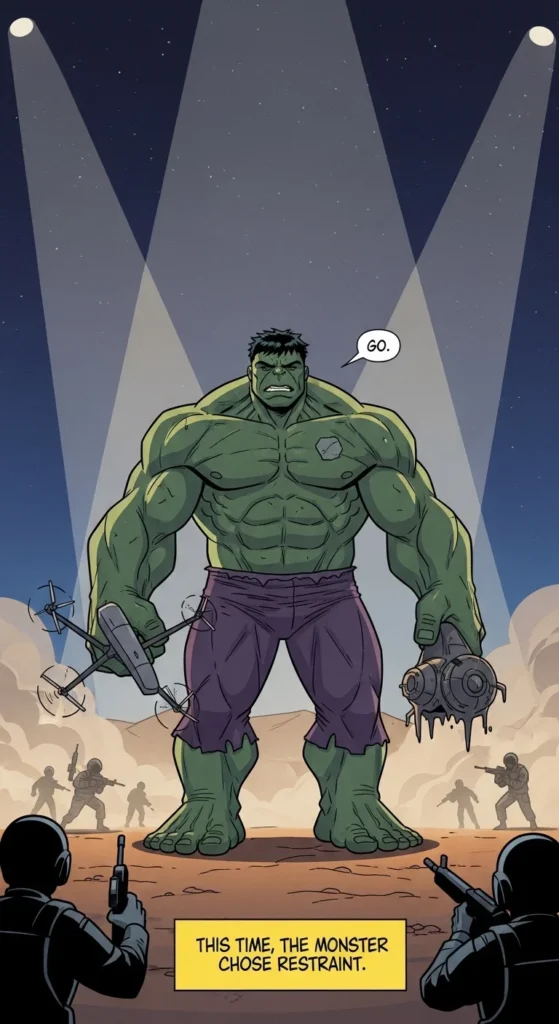
“Go,” Hulk growls—not a roar, not a threat. A command.
They hesitate. Confusion ripples through their ranks.
A drone drops down, whirring into scanning position. That changes everything. Hulk’s jaw clenches. He reaches up—not lashing out, just quick and precise—and plucks the drone from the air, leaving it blinking in his hand.
He crushes it, slow and deliberate.
Then the shooting starts.
Hulk moves—but not like before. Every step, every blow is careful. He wrecks vehicles, not people. He tosses weapons away, doesn’t break bones. When someone falls, Hulk plants himself right in front of them, taking the bullets meant for a human body.
Inside, Bruce is screaming.
Outside, Hulk is choosing.
The fight ends fast. Minutes, maybe. No one dies. Sure, people get hurt, but nothing they won’t recover from. When the last vehicle disappears over the ridge, Hulk stays put, chest heaving, watching the horizon until he’s sure they’re gone.
Only then does he kneel.
Bruce wakes hours later, naked, shaking, surrounded by twisted metal and something even stranger.
Order.
The station still stands. The path of destruction bends away from it. Everyone left behind is alive.
Bruce presses his hands into the sand, breathing hard, staring at what’s left.
Hulk didn’t lose control.
Hulk took it.
And for the first time since the gamma accident shattered his life—
3: Two Voices, One Body
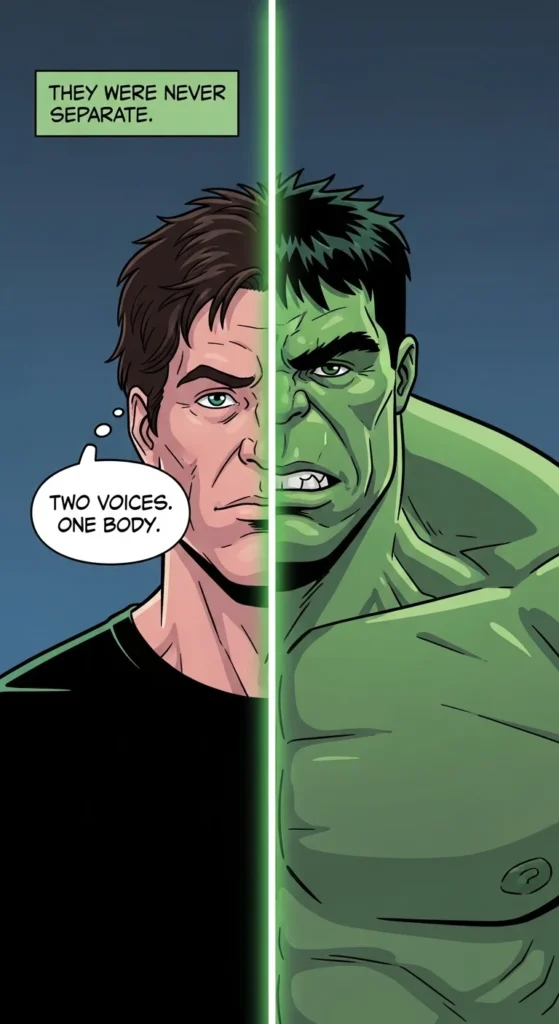
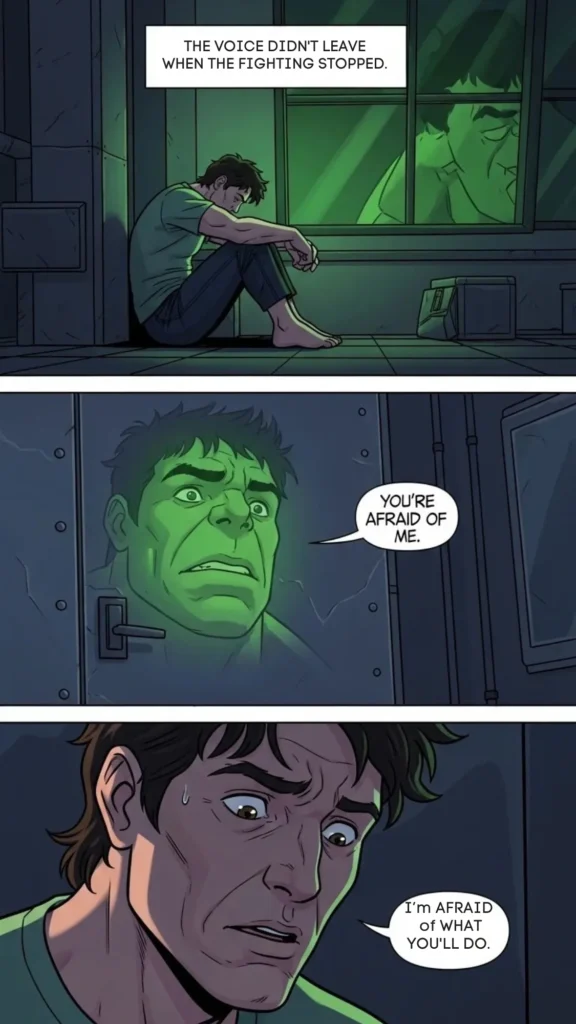
Bruce Banner doesn’t sleep anymore. Not since it happened.
Sleep means letting go. Trusting your body. Trusting your mind. Trusting that when you open your eyes, you’ll still be you. Bruce can’t count on any of that now. So he just sits there, back pressed to cold metal, knees pulled up, mind running through the fight over and over.
What really gets to him isn’t the violence. It’s the precision.
Hulk used to be pure instinct—just pain and rage lashing out. But what happened in the desert? That was different. Hulk held back. He made choices. He sized up threats, protected the station, even made sure Bruce stayed alive.
Protected him.
Bruce fumbles for his journal, hands shaking, and writes:
Hulk shows executive control. Tactical thinking. Moral judgment.
He pauses, pen hovering.
“Moral?” he mutters. “Now we’re saying the gamma monster has ethics?”
You always say things like that, the voice inside answers, calm and steady.
Bruce winces. “Don’t. Don’t act like you know me.”
That familiar, heavy pressure builds behind his eyes—not pain, more like someone waiting. Hulk doesn’t shove forward or try to take over. He just hangs there, huge and watchful, a shadow with nowhere to go.
I know you better than anyone, Hulk says. I’m what you never say out loud.
Bruce squeezes his eyes shut, fighting that old panic. This isn’t like the early days. Back then, Hulk barely had words. Just feelings, raw and wild. Now, he speaks in full sentences, every thought clear.
“When did this start?” Bruce whispers.
When you stopped listening.
It hits hard. Sinks in.
He gets up and paces, quick and jagged. “You hurt people,” he says. “That’s why I run. That’s why I keep you down.”
You’re scared of me, Hulk replies. But you’re more scared of them.
Bruce tries not to remember, but the images come anyway—labs in ruins, soldiers opening fire, crowds keeping their distance. Every time he asked for help, someone locked him up. Every time he tried to be normal, they treated him like a bomb.
“You can’t just rewrite what happened,” Bruce snaps.
Hulk doesn’t argue.
He just shows Bruce.
The memory plays out, but this time it’s through Hulk’s eyes. He sees the drone, the guns, the way some hands trembled while others gripped their triggers, eager.
They wanted to kill you, Hulk says. I wanted to stop them.
Bruce drops onto the cot, breath shallow. “You liked it.”
A pause.
I liked protecting us.
That word again.
Us.
Bruce clutches the cot. “You’re not my partner. You’re an accident.”
Hulk’s answer comes fast, clear, and cuts straight through.
Then why do you feel empty when I’m gone?
Bruce can’t answer.
Days pass, and the line between them gets thinner. Hulk keeps showing up—not as a monster, but as a presence. Bruce’s thoughts get interrupted. His reactions get sharper. Old feelings—anger, sure, but also grief, bitterness, a sense of injustice—bubble up, closer to the surface than he wants.
And Bruce starts to realize something he’s been running from: Hulk isn’t just rage. He’s everything Bruce was never allowed to be.
A few days later, another drone flies overhead. Bruce tenses, waiting for panic. It doesn’t show up. Instead, he feels something solid, steady, like a giant hand bracing his spine.
I’ve got this, Hulk says.
Bruce lets out a slow breath.
“No,” he says. “We do this together.”
The words feel risky.
They also feel right.
For the first time, Bruce doesn’t shove Hulk away. He listens. He lets Hulk speak, not as a threat, but as someone who’s part of him. He doesn’t change, not on the outside. But something shifts, deep down, and Bruce knows it’s not going back.
Somewhere else, the failed mission sets off alarms. People pore over the data. They watch every frame.
Someone notices what Bruce is only just starting to get.
The Hulk is changing.
And when people notice change, they push back. They escalate.
4: The Mindscape Where Monsters Speak
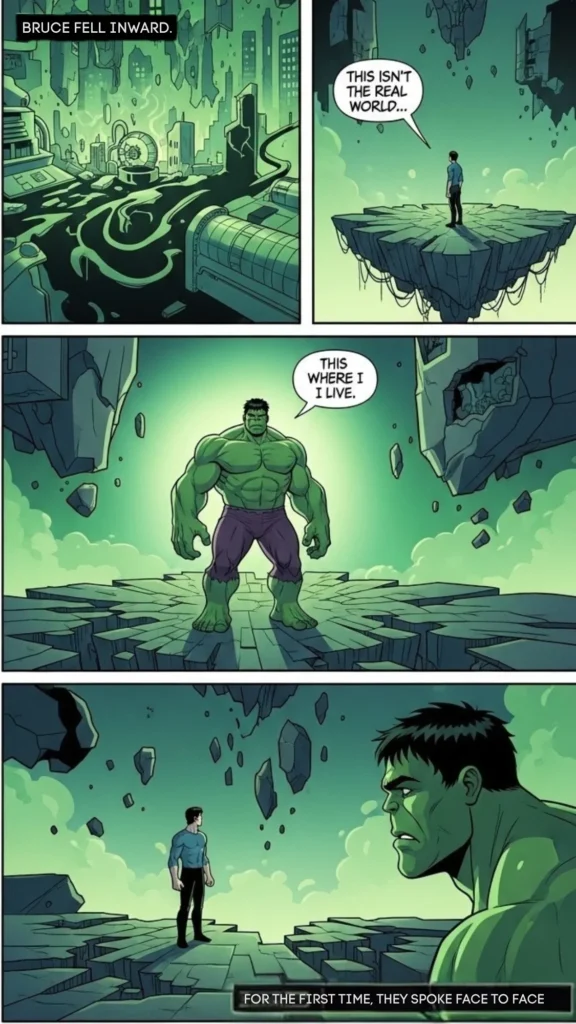
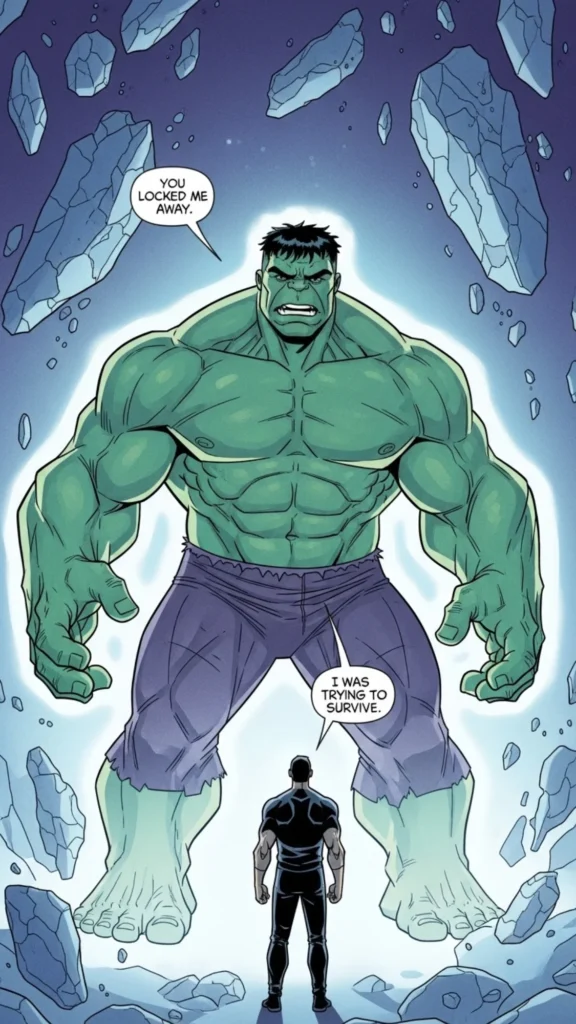
The change creeps in quietly, and that’s all Bruce Banner needs to know something’s off.
No panic. No anger. Nothing boiling over and swallowing him whole. He’s just there—standing in the weather station, looking at seismic charts that suddenly mean nothing. Then the floor doesn’t drop out; instead, it folds in on itself.
He feels heavy, but not like he’s falling. More like he’s slipping away.
Bruce reaches for the wall, but his hand slides right through, thin as mist. The whole room unravels, vanishing, replaced by this huge, endless landscape. It’s cracked and floating, all of it washed in a sickly green light. Debris and broken buildings drift by—pieces of old labs, half-remembered cities, the kind of childhood homes that never felt safe.
He knows right away where he is.
Inside his own head.
And, for once, he isn’t alone.
Hulk waits at the center, towering and solid, feet locked to the ground like he’s holding up the entire world. Except he’s not hunched or wild here. He stands straight, eyes sharp, radiating a calm authority that doesn’t need to yell.
Bruce tries to talk, but nothing comes out.
Finally, his voice breaks through, muffled and distant, like he’s underwater. “You took over. You said we’d do this together.”
Hulk turns, slow and deliberate. There’s something almost patient about his stare.
You were going to die, Hulk says. They changed the rules.
Images explode in the air—rockets prepped in silos, satellites tracking, command centers full of people. None of them see Bruce anymore, just a threat that has to be erased.
They know you pause, Hulk says. I don’t.
Bruce’s chest tightens. “So you shut me out?”
I kept you safe.
Bruce shakes his head, anger finally bubbling up. “You don’t get to make that call alone.”
Hulk steps closer. The ground shudders—not threatening, just heavy. The kind of weight that only comes from carrying too much for too long.
You built a cage and called it control, Hulk says. You buried me and wondered why the pain never stopped.
The words hit hard because they’re true.
The landscape shifts. Bruce sees flashes of old memories—strapped to lab tables, drugged without asking, studied like some dangerous puzzle. Every time he tried to reason, to explain, to be reasonable, they just locked him up.
“You think I don’t know?” Bruce snaps. “You think I don’t feel it?”
You feel it and swallow it, Hulk says. I feel it and survive.
That difference sits between them, heavy as stone.
Somewhere far away, Hulk is already moving. Bruce can sense it—muscles coiling, action, focus. Hulk tears through roadblocks, not raging, just efficient. Outposts flatten. Satellites blink out. The world panics, stories pouring in about a Hulk who never stops, never yells, never turns back.
Inside his mind, Bruce finally gets it.
This isn’t a tantrum.
It’s a campaign.
“You’re just proving them right,” Bruce says, desperate now. “This is exactly why they’re scared.”
Hulk turns to look at him—direct, not towering, not dismissive.
No, Hulk says. I’m showing them fear won’t save them.
For a second, Bruce sees it: Hulk’s logic, sharp and merciless, hammered out of pain but now clear as day. The world only listens to force, so he draws the line with strength.
But nothing comes free.
Bruce feels himself fading, his voice slipping away. Hulk’s got total control, and now Bruce finally knows what it means to be the smaller one in his own skin.
“Let me back in,” he whispers, and it’s not a demand. It’s a plea.
Hulk studies him.
Not yet.
The mindscape cracks, green light slicing through everything. Bruce gets yanked backward, deeper inside, forced to watch as the outside world shakes.
The last thing he hears before everything goes dark is Hulk’s promise—steady, unbreakable, chilling.
When this ends, they’ll never come for you again.
Bruce is left alone in the quiet, staring down the most terrifying truth of all:
Hulk’s right.
And that’s the scariest thing he’s ever known.
5: The Cost of Being Unstoppable
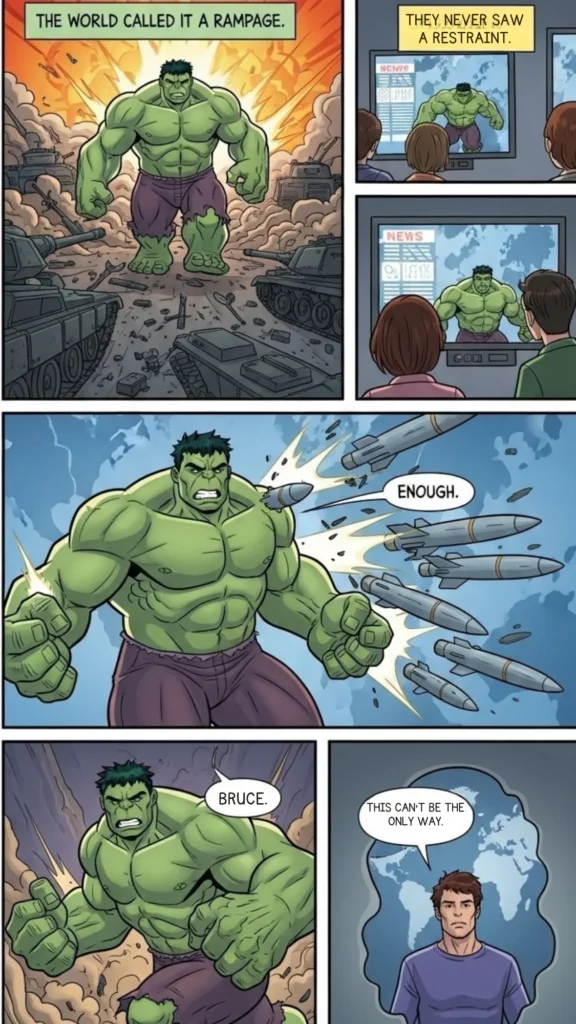
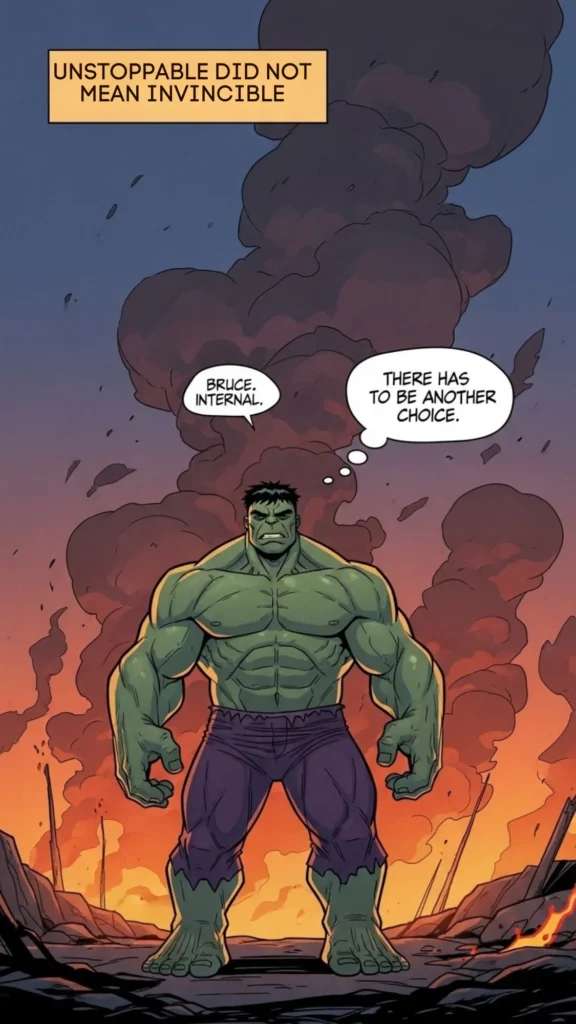
Bruce Banner regains fragments of awareness the way a drowning man catches air—brief, disorienting, never enough.
Through Hulk’s senses, he feels the world react.
Cities evacuate before Hulk ever arrives. Airspace locks down. Emergency broadcasts replace entertainment across global networks. The name Hulk trends in every language, paired with words like containment breach, global threat, doomsday protocol. Bruce doesn’t need to see the screens to know what they show. He’s lived this cycle before.
What’s different now is the silence inside.
Hulk doesn’t rage. He doesn’t roar challenges at the sky or smash indiscriminately. He moves with terrifying efficiency, targeting infrastructure rather than people. Military convoys are stopped without casualties. Weapons systems are disabled, not destroyed beyond repair. Facilities designed to track or cage him are erased from the map with surgical precision.
The world watches in horror, unable to understand restraint from something that looks like a god of violence.
Inside the mindscape, Bruce struggles against the boundaries Hulk has erected. He runs through corridors of memory, calling out, demanding, pleading. The environment resists him—walls thicken, pathways collapse. Hulk isn’t punishing him.
He’s prioritizing.
Bruce finally breaks through at the edge of a fractured cityscape—an echo of New York, warped and floating in green haze. Hulk stands overlooking it, arms crossed, watching the physical world through invisible senses.
“You’re scaring them,” Bruce says, breathless.
They were already afraid, Hulk answers. Fear is not my responsibility.
Bruce steps beside him, staring at the warped skyline. “And what about the people who get caught in this? The ones just trying to live?”
Hulk’s jaw tightens.
I avoid them.
“That’s not the same as protecting them.”
The difference matters to Bruce, and Hulk knows it.
Outside, a new response unfolds. This isn’t a local task force or a shadow operation. This is coordinated. Global. Assets are mobilized that haven’t been deployed in decades—experimental weapons, enhanced operatives, contingency plans designed for extinction-level threats.
Bruce feels the shift like a pressure drop.
“They’re escalating,” he says urgently. “You’re forcing their hand.”
Hulk turns slowly. Good.
The word chills Bruce.
“This ends with you alone,” Bruce warns. “No allies. No place to hide. No future.”
Hulk looks at him then—not with anger, but with something far more unsettling.
I was born alone.
The truth of that statement hits Bruce harder than any explosion ever could.
For all his calculations and theories, Bruce has never fully acknowledged the loneliness Hulk embodies. Created in violence. Met only with fear. Used as a weapon or treated as a disaster. Hulk has never been allowed to exist without being framed as a problem.
Bruce softens. “You don’t have to do this by yourself.”
You never let me before.
Outside, the breaking point arrives.
A weapon is launched—not at Hulk directly, but at a nearby uninhabited region. A demonstration. A warning wrapped in fire and radiation. The message is clear: Stand down, or we escalate further.
Hulk stops moving.
For the first time since taking control, he hesitates.
Bruce feels it immediately—the flicker of uncertainty, the calculation shifting.
“That’s it,” Bruce says quietly. “This is the line. You cross it, and there’s no coming back.”
Hulk clenches his fists. The ground around his physical body fractures under the pressure of indecision.
They will keep doing this, Hulk says. Again and again. They will burn the world to stop us.
“Only if you let them define the terms,” Bruce replies. “You’re proving you’re unstoppable. Now prove you’re more than that.”
The silence stretches, heavy with consequence.
For the first time, Hulk doesn’t push Bruce away.
He opens the boundary.
The sensation is violent—two consciousnesses rushing together, overlapping, clashing, then stabilizing. Bruce feels the weight of Hulk’s strength surge through him, while Hulk absorbs Bruce’s empathy, restraint, and fear of collateral damage.
Together, they step forward.
The next move won’t be about dominance.
It will be about choice.
And the world, watching in terrified anticipation, has no idea which version of the Hulk it’s about to meet.
6: When Two Become One
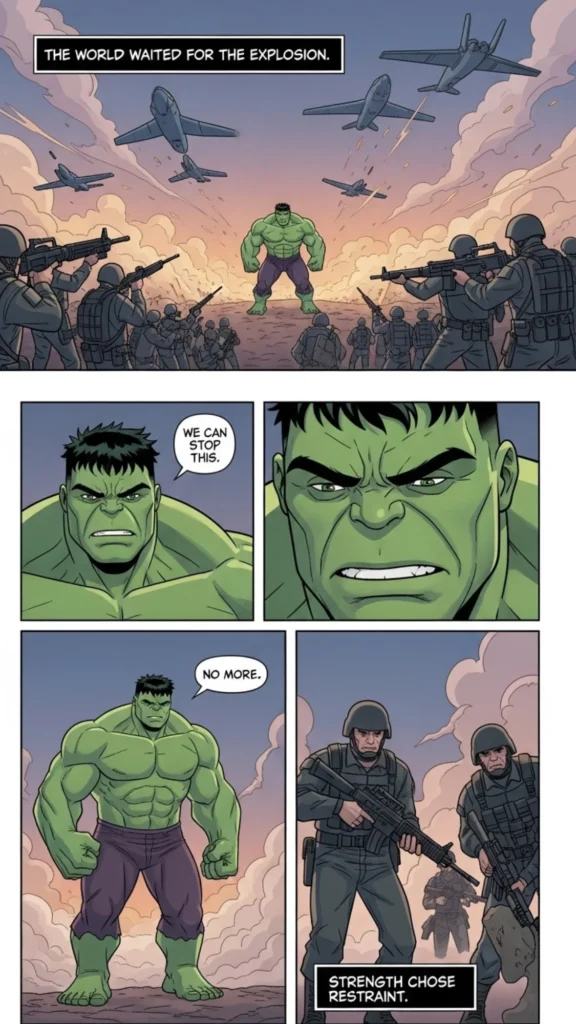
Bruce Banner comes back to himself in flashes—like a guy gasping for air underwater. It never lasts long, and it’s never enough.
He sees through Hulk’s eyes, feels the world flinch before he even shows up. Cities empty out. Planes stay grounded. TV and radio drop everything for emergency alerts. “Hulk” lights up every news feed, always paired with words like “containment,” “global threat,” “doomsday.” Bruce doesn’t need the headlines. He already knows how this plays out.
This time, though, the inside of his head is quiet.
Hulk isn’t rampaging. No wild roars, no smashing for the sake of smashing. He moves with a calm, terrifying purpose. Infrastructure goes down, but people aren’t hurt. Military convoys get stopped in their tracks, but no one dies. Missiles and tanks get neutralized, not obliterated. All those labs built to hunt or trap him? Hulk wipes them out—clean and precise.
People watch, horrified. They can’t make sense of it. How does a monster suddenly show mercy?
Inside their shared mind, Bruce fights to get through. He runs through memories, shouting, begging, demanding answers. But the mental walls keep closing in. Hulk isn’t punishing him.
He’s focused.
Bruce finally breaks through at the edge of a strange city—New York, but twisted, washed in green fog. Hulk stands at the edge, arms folded, staring out at the world through senses Bruce can’t even name.
“You’re scaring them,” Bruce says, panting.
They were already scared, Hulk answers. That’s not my problem.
Bruce stands with him, staring at the warped skyline. “What about the people in the middle? The ones just trying to live?”
Hulk’s jaw tightens.
I avoid them.
“That’s not the same as protecting them.”
Bruce cares about that. Hulk knows it.
Then, outside, the stakes change. This isn’t the usual SWAT team or secret agency. This is global—the big guns, pulled out of storage. Weapons no one’s supposed to use, operatives with classified names, plans meant for doomsday.
Bruce feels everything shift, like the air just got heavier.
“They’re escalating,” he says. “You’re forcing them.”
Hulk turns. Good.
That word makes Bruce go cold.
“This ends with you alone,” Bruce warns. “No friends. Nowhere to go. Nothing left.”
Hulk meets his eyes. No anger—just something deeper.
I was born alone.
That hits Bruce harder than any explosion. For all his science and strategies, he’s never really faced how lonely Hulk is. Made in violence, always feared, always used, never just allowed to be. Hulk’s never been anything but a problem to solve.
Bruce softens. “You don’t have to do this alone.”
You never let me.
Outside, it happens. A weapon launches—not at Hulk, but close enough to make a point. It hits empty land, but the fire and radiation send the message: Stand down or we go further.
Hulk stops. For the first time since taking over, he actually hesitates.
Bruce feels it instantly—the doubt creeping in, the calculations shifting.
“That’s it,” Bruce says, voice low. “This is the line. You go past it, and there’s no way back.”
Hulk’s fists clench. The ground around him cracks. He’s caught, stuck between choices.
They’ll keep doing this, Hulk says. Over and over. They’ll burn everything to stop us.
“Only if you let them call the shots,” Bruce says. “Everyone knows you can’t be stopped. Now show them you’re more than that.”
Silence, thick and loaded.
For once, Hulk doesn’t shut Bruce out.
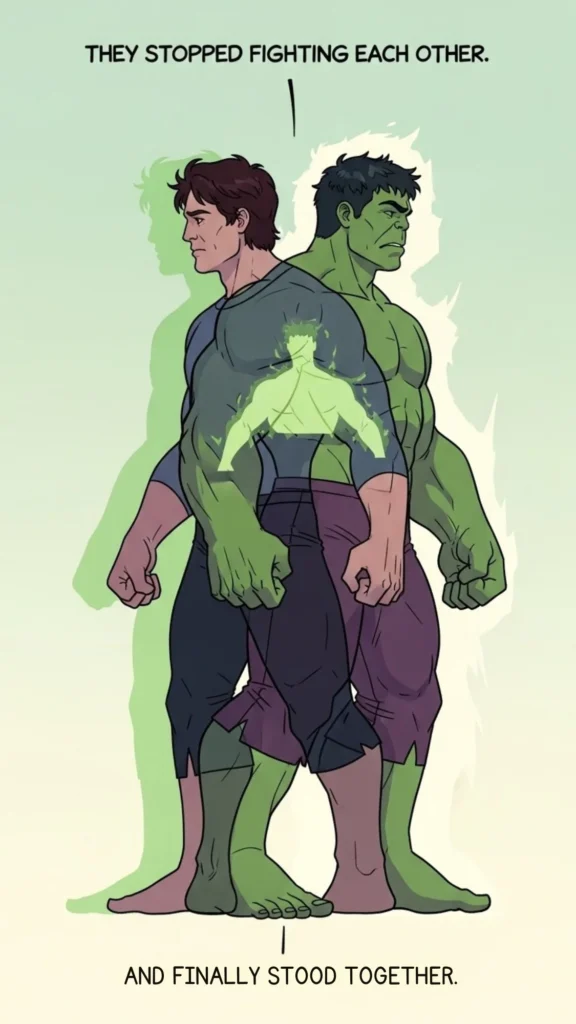
He opens up.
It’s like a flood. Their minds crash together—fighting, merging, then settling. Bruce feels Hulk’s power pour into him, and Hulk takes on Bruce’s empathy, his fear for the innocent, his urge to hold back.
Together, they move forward.
This time, it’s not about being in control.
It’s about making a choice.
And outside, the world waits, terrified—no idea which Hulk it’s about to meet.
7: What Remains After the Rage
The world doesn’t flip upside down in a single night.
Bruce Banner knows this better than most. Systems built on fear don’t just unravel because the thing they’re afraid of refuses to play along. Behind closed doors, people still hold meetings. There are still files stamped “active contingency.” Some folks will always see Hulk as a disaster barely dodged.
But something’s changed. Really changed.
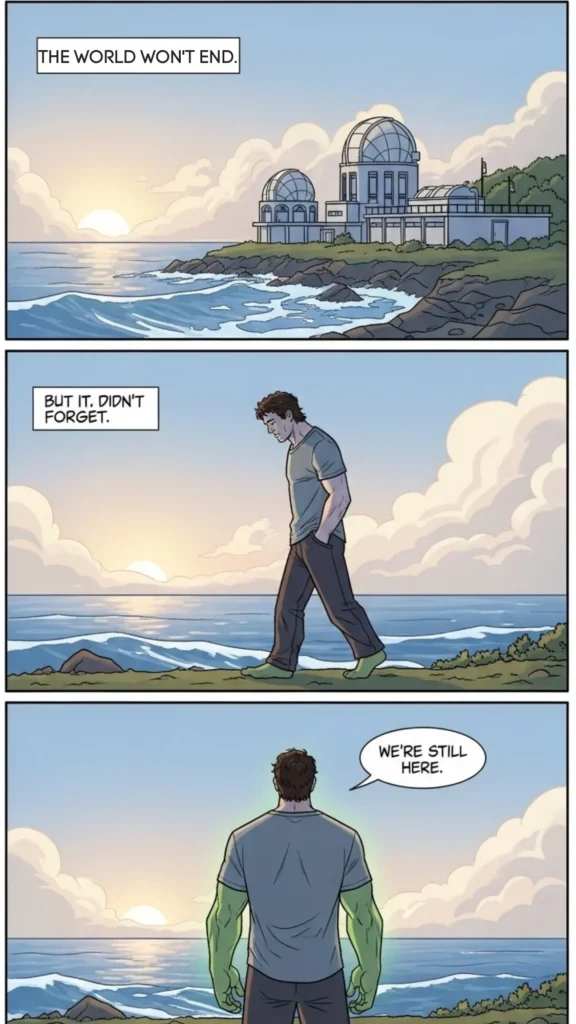
Bruce picks a place that isn’t exactly hidden, but he doesn’t broadcast it either—a coastal research site, long abandoned, stripped of cameras and left to the wild. It’s close enough to town that he doesn’t feel cut off, but far enough that nobody’s in danger. And for once, he’s here because he wants to be, not because he’s running away.
Hulk is quieter these days.
Not gone—never gone—but not battering at Bruce’s mind like a storm desperate to break out. He’s just there, a steady weight, a warmth. Present, but not in a hurry.
You’re tired, Hulk says.
Bruce gives a little smile. “We both are.”
Days slide by, then weeks.
Bruce works again. Not in secret, not churning out weapons for people in suits. He’s working for himself now. His research is all about stability, not suppression. He’s trying to figure out how two clashing instincts could end up sharing space inside the same mind.
Doesn’t always go smoothly. Sometimes anger flares, Hulk stirs, and Bruce has to talk them both down. Some days, Hulk feels remote, like he doesn’t know where he fits now that nobody’s calling on him to save the day.
That’s when Bruce talks to him.
Not as a problem.
As a partner.
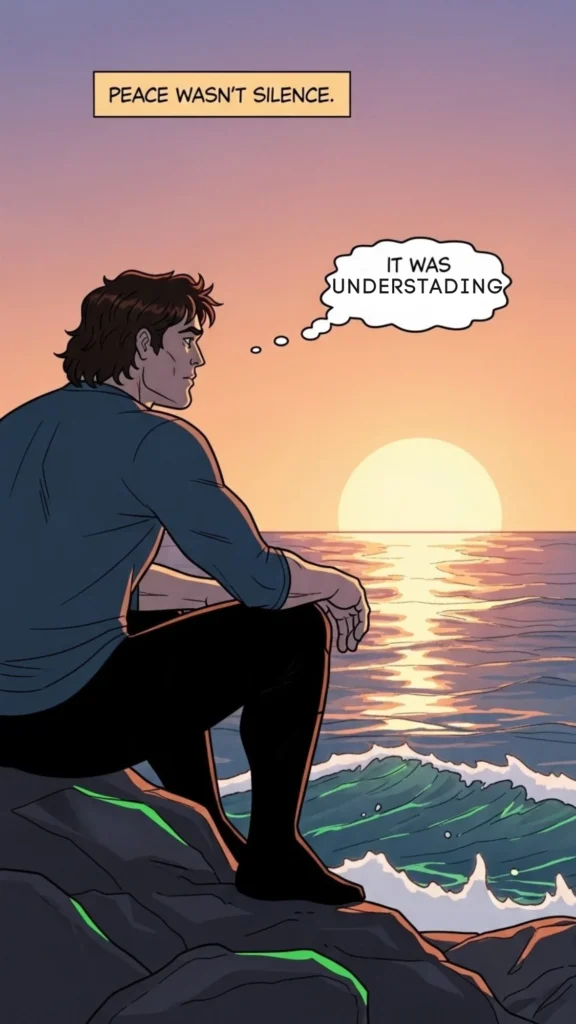
“You’re not just here for emergencies,” Bruce tells him one night, staring at the ocean. “You get to exist too.”
Hulk doesn’t answer right away.
I don’t know how, he finally says.
Bruce nods. “Me neither. We’ll figure it out.”
News from the outside world trickles in. Reconstruction. Policy debates. A few people finally admit that the old way—containment, control—never worked because it ignored things like consent, dignity, and the idea of working together.
No one apologizes.
Bruce never expected them to.
What matters is, people are watching now—not for explosions, but for proof that power doesn’t always mean destruction.
One night, long after the lights have gone out, Bruce dreams.
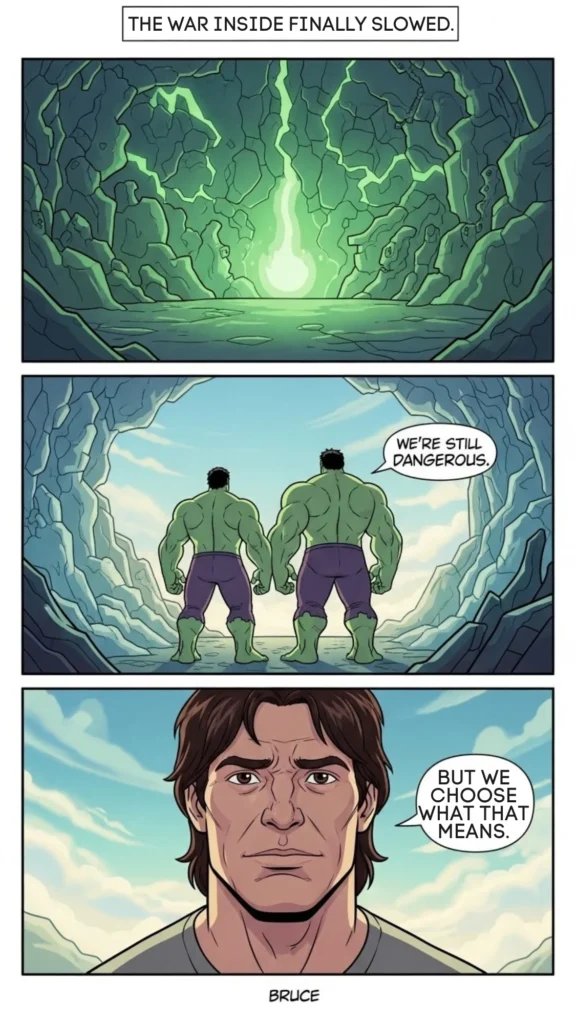
He’s back in his mindscape. It’s different now. The broken ground has started to settle. The sky’s clearer. Instead of floating, disconnected pieces, there are paths—connections where there weren’t any before.
Hulk stands next to him. Not looming. Not distant. Just there.
We’re still dangerous, Hulk says.
Bruce nods. “Yeah.”
That won’t change.
“No,” Bruce says. “But danger isn’t the same as evil.”
They stand together, looking out.
Somewhere, people still fear the Hulk. Somewhere else, people dare to hope. Both things are true—and probably always will be.
Bruce can live with that.
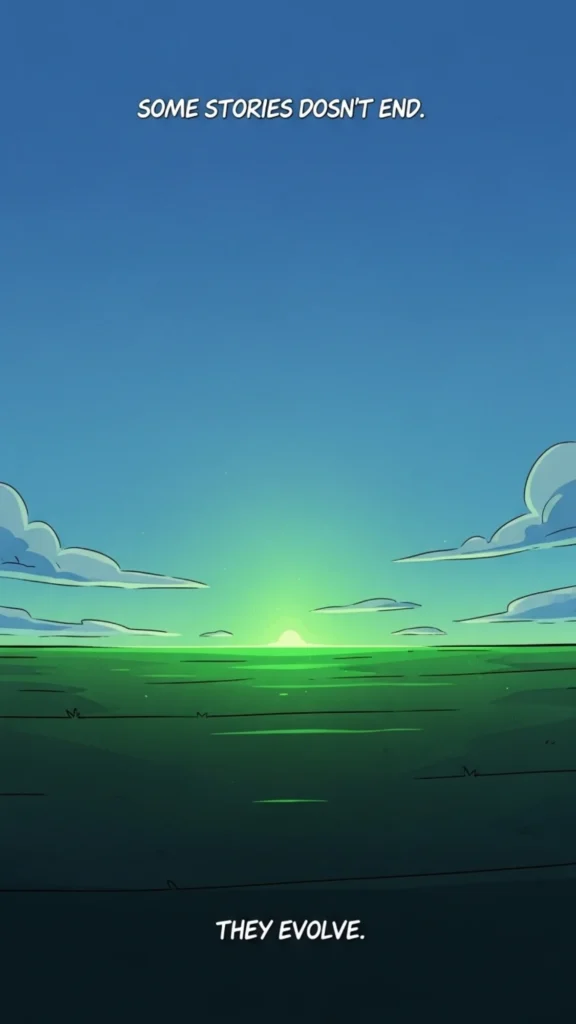
As long as he and Hulk keep being honest, as long as strength and empathy share the same body, this story doesn’t have to end in tragedy.
It can stay unfinished.
Wide open.
Because real evolution was never about getting stronger.
It was about having a choice.