Baby Blues: One Perfectly Chaotic Day with the MacPhersons
It started, as most things in the MacPherson house started, with a sound.
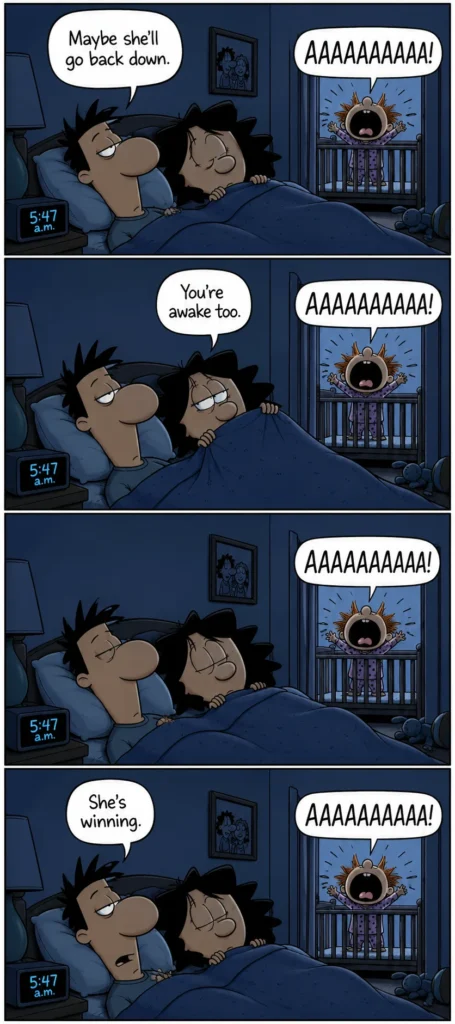
Not an alarm. Not a knock. Not the pleasant trill of birds outside a sunlit window. It was Wren — two years old, approximately fifteen pounds of pure unfiltered willpower — standing in her crib at 5:47 a.m., pressing her face between the slats, and producing a noise somewhere between a fire drill and a sea mammal in distress.
Darryl MacPherson did not move.
Wanda MacPherson did not move either.
They lay in the dark, side by side, both perfectly still, both completely awake, both absolutely refusing to be the first one to acknowledge it.
Wren escalated.
Darryl cleared his throat softly, the universal signal for I am technically still asleep.
Wanda pulled the blanket one inch higher, the universal signal for nice try.
This standoff lasted four full minutes before Darryl, a man who once negotiated a regional budgetary integration plan across eleven departments, was defeated by a toddler and a blanket. He shuffled down the hall in mismatched socks. Wren looked up at him from the crib with an expression of total triumph and held out her arms. He picked her up. She immediately grabbed his ear and pulled.
“Good morning to you too,” Darryl said.
By seven o’clock the kitchen was fully operational, which is to say it looked like a small explosion had occurred in the cereal aisle of a grocery store. Zoe, age nine, sat at the table reading the back of a cereal box with the focused intensity of someone studying for a bar exam. Hammie, age seven, was not sitting at the table. Hammie was technically near the table, in the sense that some part of him was making contact with his chair at most intervals, but the rest of him — his left leg, his right elbow, and the majority of his attention — was somewhere else entirely.
“Hammie,” Wanda said, without looking up from the stove. “Sit in the chair.”
“I am sitting in the chair.”
“Both feet on the floor.”
A pause.
“Define floor.”
Wanda put down her spatula.
Hammie put both feet on the floor.
Across the table, Zoe turned a page. She was wearing a pink sweater that did not belong to her, had not belonged to her yesterday either, and technically belonged to her best friend Keesha, but Zoe and Keesha had swapped so many items of clothing over the years that neither family was entirely sure what originated where anymore. This was not a problem. This was just Tuesday.
“Mom,” Zoe said, still reading, “Hammie took my eraser yesterday.”
“I needed it,” Hammie said.
“For what?”
“Stuff.”
“What stuff?”
“Important stuff.”
Zoe set down the cereal box and turned to face him with the full measured gravity of a nine-year-old who has been waiting to have this exact conversation. “Mom. He took my eraser for stuff.“
“Hammie,” Wanda said.
“It was a truck-shaped eraser,” Hammie said, as if this explained everything. “I wasn’t going to erase anything with it. It was just going to live in my pocket.”
“That’s not—”
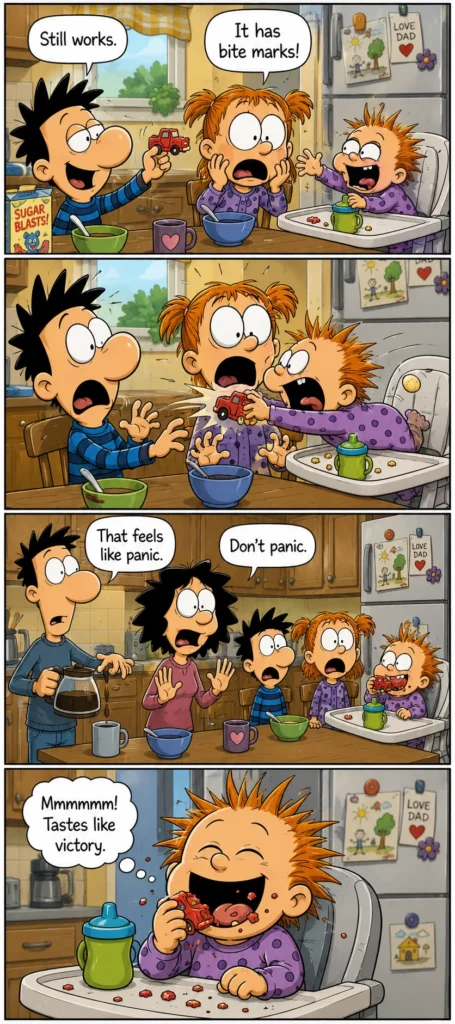
“It’s fine now,” Hammie said, and produced the eraser from his pocket. The truck-shaped eraser, which had previously been red, was now missing one wheel and had a small bite taken out of the cab.
Zoe stared at it.
Wren reached across from her high chair and grabbed it.
Everyone stared at Wren.
Wren put the eraser in her mouth.
“Wren, no,” said Darryl, who had just walked in carrying the coffee pot.
Wren looked at him.
She did not take the eraser out of her mouth.
“She’s tasting it,” Hammie said, with genuine scientific interest.
“She is not tasting it,” Wanda said.
“She’s definitely tasting it.”
Darryl fished the eraser out of Wren’s mouth. Wren looked betrayed. Then she grabbed a piece of Darryl’s toast instead, held it above her head like a trophy, and crammed it into her mouth before anyone could intervene.
“That was my toast,” Darryl said.
Wren chewed.
At 8:15, Darryl stood in the bedroom in his work clothes, frowning. Something was wrong. He couldn’t pinpoint it immediately, but something about the morning felt slightly off, the way a picture hung one degree crooked looks fine until you stand back.
He looked down.
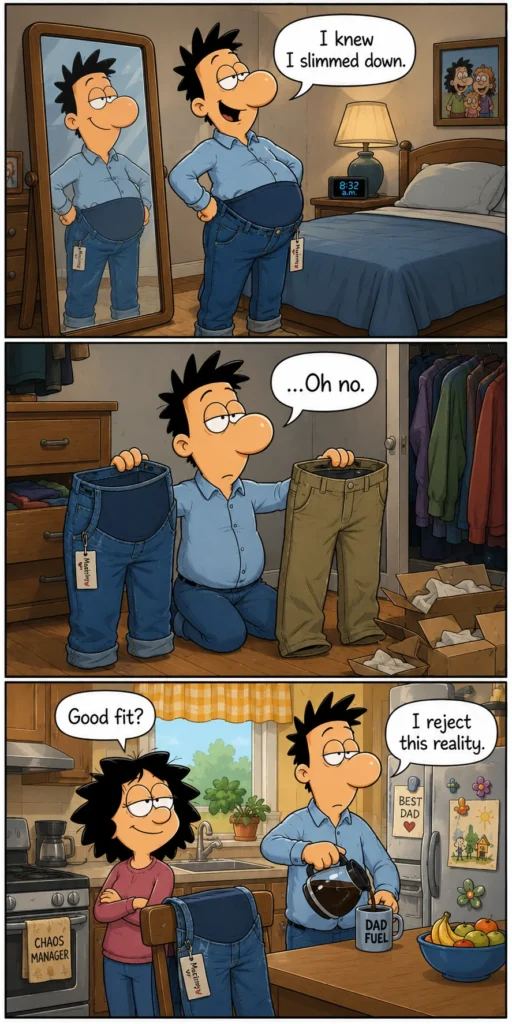
The pants. The pants felt different. Comfortable in an unusual way. A forgiving way. A suspiciously forgiving way.
He went to the closet. He compared. He stood very still for a moment.
He walked back to the bathroom mirror and looked again at the pants he was wearing.
Wanda’s maternity jeans.
He had been wearing Wanda’s maternity jeans for twenty minutes. He had complimented himself on them getting dressed. He had thought, these are great, I must have lost some weight.
He went back to the closet. He found his actual pants. He changed in complete silence. He walked to the kitchen. He poured his coffee. He did not say a word.
Wanda glanced at him over her shoulder.
He met her eyes.
She looked at his previous pants, crumpled on the chair.
A slow smile crossed her face.
“Good fit?” she said.
“I have no idea what you’re talking about,” Darryl said, and walked out the front door.
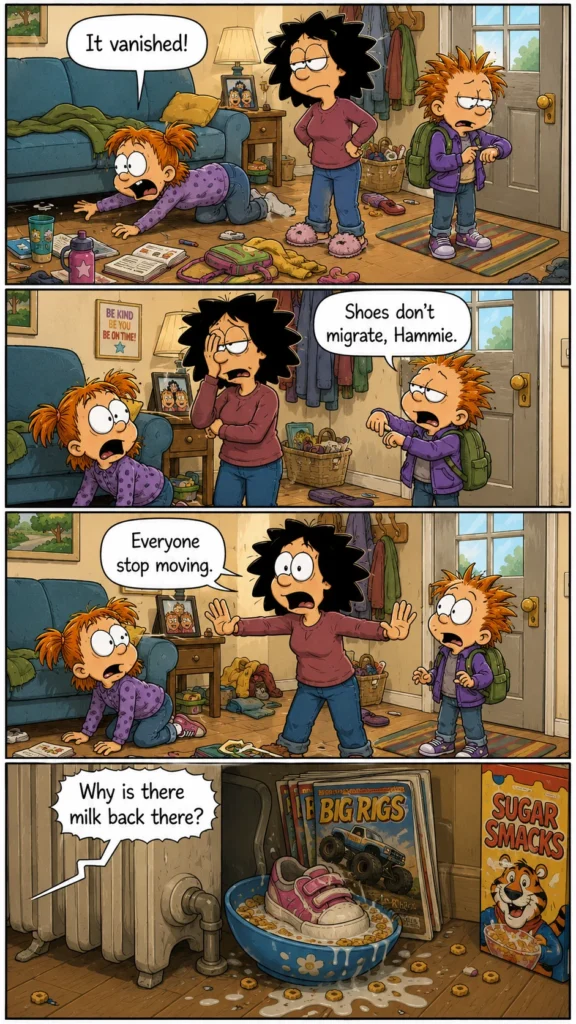
The school run was a fifteen-minute exercise in logistics that somehow always took thirty. Hammie could not find his left shoe. Not the right shoe — the right shoe was on the bottom step exactly where Wanda had put it. The left shoe had vanished into a dimension that existed only for single shoes and television remotes.
“I had it,” Hammie said, looking under the couch.
“When?” Wanda asked.
“Yesterday.”
“You wore it yesterday.”
“I know.”
“So where is it?”
Hammie looked at her as if she had asked him to explain the nature of time. “That’s what I’m trying to figure out.”
Zoe, standing at the door with her backpack on, checked her watch. She did not own a watch. She made the gesture anyway.
The shoe was found behind the radiator, inside a cereal bowl, underneath a small pile of truck magazines that technically belonged to Hammie, technically should have been in his room, and technically had nothing to do with where a left shoe ends up, and yet there it all was.
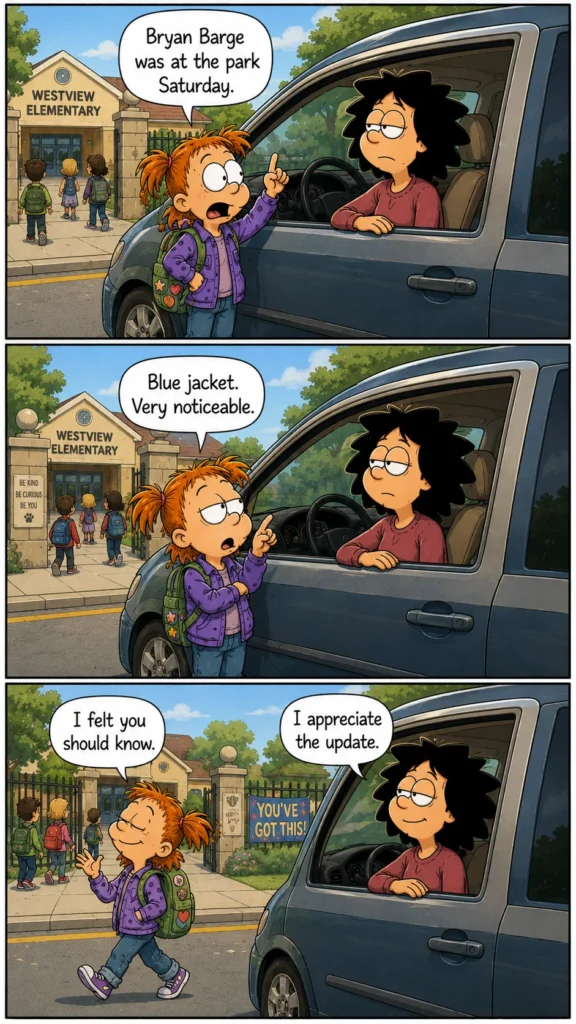
They made it to school with two minutes to spare. Hammie jumped out of the minivan, said “bye” to the cup holder rather than his mother, and ran inside. Zoe got out with perfect posture, adjusted her backpack straps, and turned back to Wanda with the specific expression she wore when she had been saving something to say.
“Mom,” Zoe said. “Bryan Barge was at the park on Saturday.”
“That’s nice, honey.”
“He was wearing a blue jacket.”
“Okay.”
“I just wanted you to know.”
“I appreciate that,” Wanda said.
Zoe nodded, as though the information had been formally received and filed, and walked into school.
The MacPherson minivan was, by any objective measure, a disaster. Wanda had read somewhere that the average car seat contained more bacteria than a toilet seat. She had chosen not to think about this. There were crayon drawings on the interior paneling that she was reasonably sure predated Wren. There was a juice box under the passenger seat whose expiration date may have been historic. There was a single right-foot rain boot in the back, and she had long since stopped wondering where the left one was.
She drove home through the neighborhood past Bunny’s house, which had a freshly trimmed hedge, a seasonal wreath on the door, and absolutely no visible evidence that children lived inside it. Wanda had once been inside Bunny’s house. She had stood in the kitchen and noticed there was not a single handprint on the refrigerator. Not one. Not anywhere. She had thought about this for two weeks.
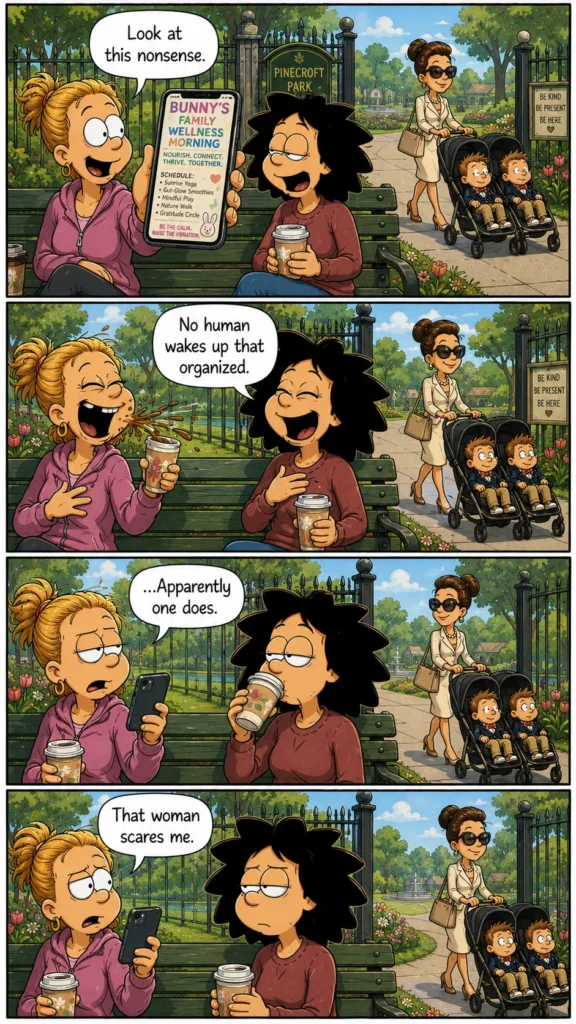
She met Yolanda at the park at nine-thirty. Yolanda had coffee. Wanda had coffee. They sat on the bench like two veterans briefly returned to a peaceful country, enjoying the specific silence of a park with no children in it.
“Bunny sent a message to the neighborhood group chat,” Yolanda said, looking at her phone.
“I saw it.”
“She’s organizing a family wellness morning.”
“I know.”
“She made a flyer.”
“A laminated flyer,” Wanda said.
They both stared at the empty swing set.
“Her twins were wearing matching corduroy blazers at the school gate,” Yolanda said.
“Were they?”
“I don’t own a blazer. I own a fleece and a hooded sweatshirt that says LAKE TAHOE 2019 and I haven’t been to Lake Tahoe.”
“Whose is it?”
“I have no idea.” Yolanda sipped her coffee. “Her kids look like the cover of a catalog.”
“She named them both Wendell,” Wanda said.
“I know.”
“One is Wendell John. One is Wendell Jon.”
“I know.”
“You cannot tell them apart by name. You cannot tell them apart by looking at them. She has created two children who are, for all functional purposes, one child with a backup.”
Yolanda nodded slowly. “I respect the efficiency.”
Wanda laughed so hard she spilled her coffee.
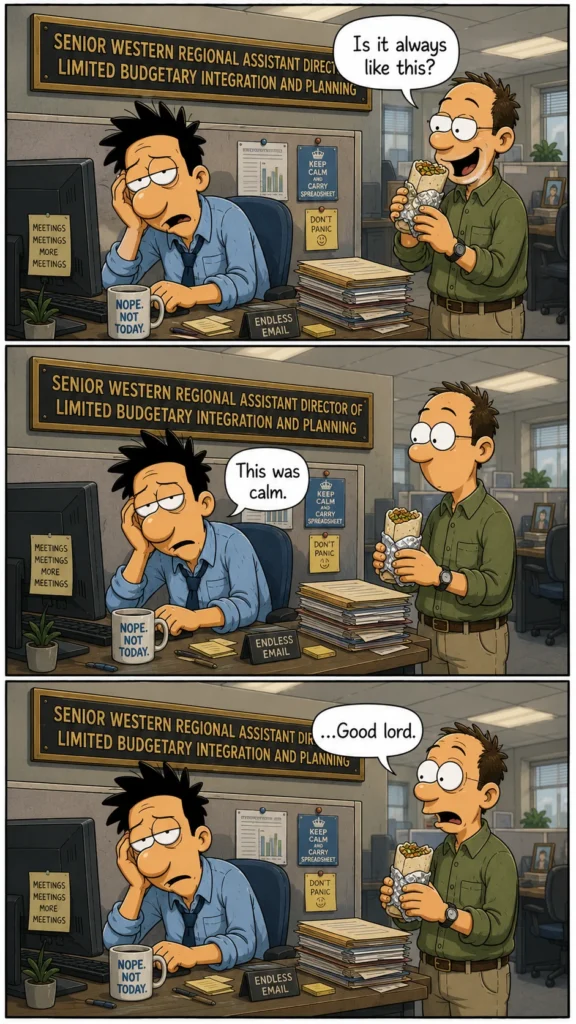
Darryl arrived at the office to find his coworker Kenny already at his desk, eating a breakfast burrito with the serene calm of a man whose mornings belonged entirely to him.
“You’re late,” Kenny said.
“Shoe crisis.”
“Which kid?”
“Hammie. Found it in a cereal bowl.”
Kenny took a bite of his burrito and appeared to consider this. “Behind the radiator?”
“Behind the radiator.”
“Standard,” said Kenny, who had no children and was therefore able to assess these situations with the detached clarity of a documentary narrator.
Darryl sat down, logged in, and stared at his screen. Senior Western Regional Assistant Director of Limited Budgetary Integration and Planning. Fourteen words. He had once timed how long it took to read his own title aloud. Four seconds. A record, probably.
“Hammie tried to give the baby an eraser this morning,” Darryl said.
“Was it successful?”
“She ate part of it.”
“Part?”
“He’d already bitten off the other part.”
Kenny set down his burrito. He looked at Darryl for a long moment. “I’m going to ask you something and I need you to answer honestly.”
“Okay.”
“Is it always like this?”
Darryl thought about the maternity jeans. He thought about the shoe in the cereal bowl. He thought about Wren’s expression of pure triumph at 5:47 a.m.
“This,” Darryl said, “was a calm morning.”
At three o’clock, Hammie came home from school, dropped his backpack in the exact center of the hallway where it would cause maximum inconvenience, and located Trent within six minutes via a system of communication that appeared to involve no phone and no plan and yet always seemed to work.
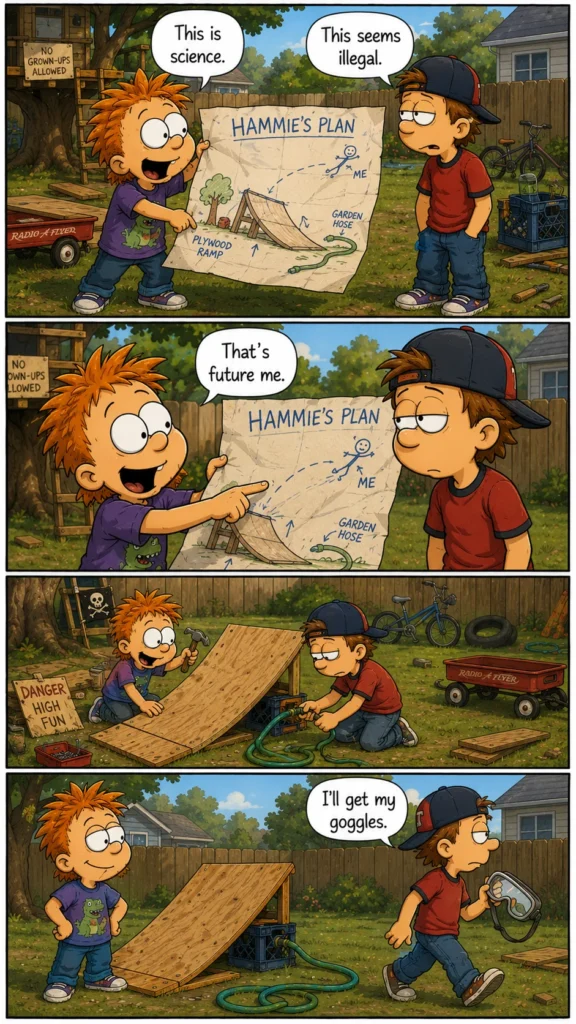
They stood in the backyard with a hand-drawn diagram on a piece of paper that had been folded and unfolded so many times it was developing structural failure along the creases.
“Okay,” Hammie said, pointing at the diagram. “So the trampoline goes here.”
“We don’t have a trampoline,” Trent said.
“The Walkers have a trampoline.”
“We’re not allowed in the Walkers’ yard anymore.”
Hammie looked up from the diagram. “That was one time.”
“It was three times.”
“Three separate incidents that were all part of one extended sequence of events,” Hammie said.
Trent looked at the diagram again. He was, of all the people in Hammie’s life, the one most likely to ask the important questions. “What happens if the hose misses the ramp?”
“It won’t miss.”
“But if it does.”
“It won’t.”
“Hammie. If it does.”
Hammie considered this with genuine scientific seriousness. “Then we get wet. Which is fine because we’d be wet anyway from the hose.”
“That is the most circular logic I have ever heard.”
“It’s not circular. It’s a circle that goes in the right direction.”
Trent looked at the diagram. He looked at the yard. He looked at Hammie. “I’ll get my goggles,” he said.
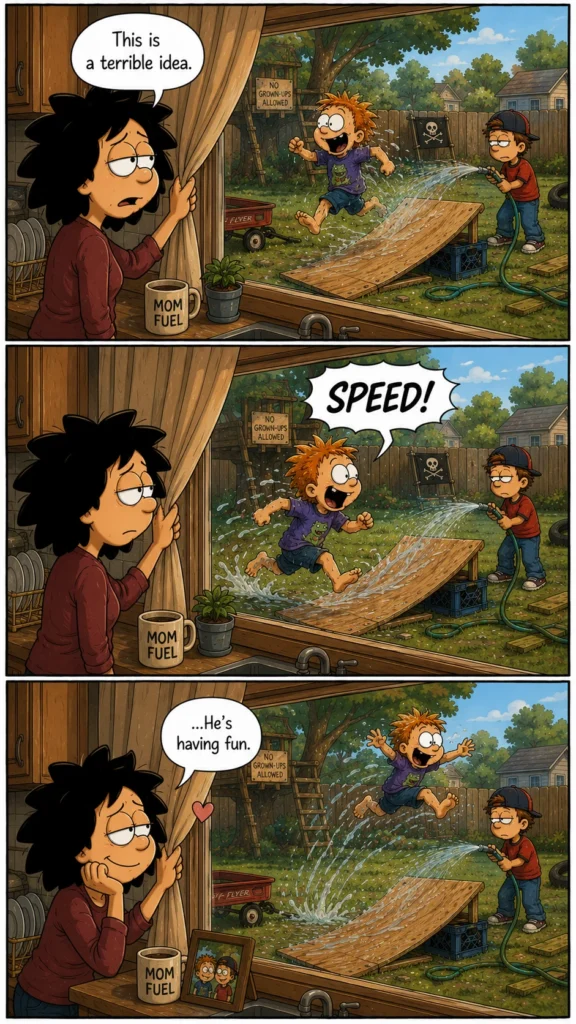
Wanda heard the screaming from the kitchen and did not immediately go to the window. This was not neglect. This was experience. There was a screaming that meant danger and a screaming that meant fun, and after seven years of Hammie, she could distinguish them the way a sommelier distinguishes vintages — by tone, by pitch, by the subtle secondary note underneath.
This was fun screaming.
She went to the window anyway.
Hammie and Trent were completely soaked. The hose was running. There was a ramp made of plywood leaned against the fence. Neither of them appeared to be injured. Hammie was standing on the ramp with his arms out like he was surfing something that hadn’t arrived yet.
He jumped.
He landed.
He immediately went to get a running start.
Wanda watched this for a moment. She watched Trent, who was apparently serving as the hose operator and had the careful concentration of a man performing a job he felt ambivalent about.
She could stop it. She had the words ready. She had the expression ready. She had the full speech, polished by years of deployment, about why this was going to end badly and what specifically was going to happen to whom and what part of stop was proving difficult to understand.
She looked at Hammie’s face as he ran up the ramp.
Pure joy. Absolute, unmediated, hundred-percent-pure joy, like the distilled essence of being seven years old and not knowing yet that there were things worth worrying about.
She let the curtain fall back.
She went back to the stove.
She was going to regret this. She knew that. The regret was approximately forty minutes away, in the form of two soaking wet boys who needed towels and dry clothes and dinner, in that order.
But right now Hammie was laughing, and the sound came through the kitchen window like something you didn’t know you needed to hear.
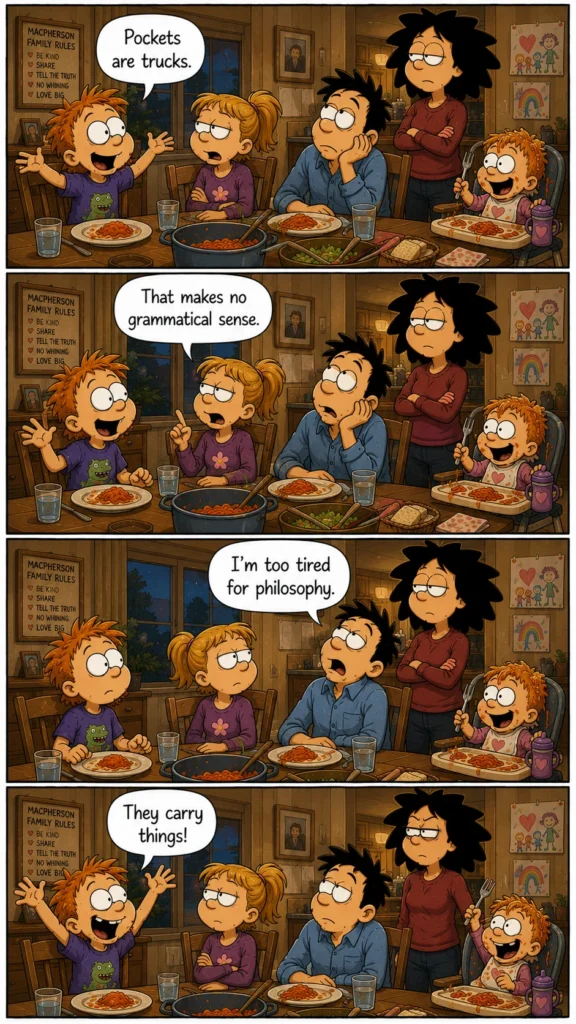
Dinner was pasta, because dinner was always pasta on Tuesdays. This was a rule Wanda had implemented six months ago as part of a broader attempt to impose structure on a household that treated structure the way weather treats a paper bag. Monday was tacos. Tuesday was pasta. Wednesday was supposed to be something else but had so far been pasta again, because pasta was the one meal that could be assembled while simultaneously mediating three separate disputes and answering a question about why trucks didn’t have wings.
“Why don’t trucks have wings?” Hammie asked, fork in hand, pasta untouched.
“Because they’re trucks,” Darryl said.
“But if they had wings—”
“They’d be planes,” Zoe said.
“Planes don’t carry as much stuff.”
“Planes carry a lot of stuff.”
“Not truck amounts of stuff.”
“There are cargo planes—”
“I mean truck-truck amounts—”
“What is a truck-truck amount—”
“Zoe. Hammie.” Wanda did not raise her voice. She had long since discovered that raising her voice in this house was like shouting into a wind. You made noise. The wind continued. She simply said their names in a specific frequency that landed somewhere between the ears and the spine. Both children stopped.
Wren, who had been quietly applying pasta to her hair for the last four minutes, looked up and said, “Twuck.”
Hammie pointed at her. “See? She agrees with me.”
“She does not agree with you,” Darryl said. “She is putting pasta in her hair.”
“She said truck.”
“She says truck about everything. She said truck about the mailbox this morning.”
“Mailboxes are kind of like trucks,” Hammie said. “They both carry things.”
Darryl put down his fork. He looked at the ceiling for a brief moment, the way a man looks at the sky when he is asking it something it cannot answer.
“By that logic,” Zoe said, with the careful precision of someone who had decided to be helpful and was about to make everything worse, “a pocket is also a truck.”
Hammie’s eyes went wide. “Pockets are trucks,” he said.
“They are not trucks,” Wanda said.
“They carry things.”
“Hammie—”
“Small things, but still—”
“Eat the pasta.“
After dinner, after the dishes, after Wren’s bath — which was its own category of event, a twelve-minute operation involving three towels, one rubber duck, and a volume of splashing that left the bathroom floor requiring its own separate toweling — after the teeth brushing and the pajama argument and the book that Zoe had already read but Hammie hadn’t and Hammie did not want to hear it which meant Zoe read it to herself inside the room while Darryl read a different book to Hammie in the hallway — after all of that, the house went quiet.
It was nine-fifteen.
Darryl sat on the couch with the remote, staring at a television he had not turned on. Wanda sat beside him with a cup of tea going cold on the end table. Wren was asleep. Hammie was asleep. Zoe was probably still awake reading by flashlight but this was their arrangement — she got to read past bedtime as long as no one officially knew about it.
“He said pockets are trucks,” Darryl said.
“I know.”
“I can’t actually find a flaw in the argument.”
“Neither could I.”
The house made its nighttime sounds. The radiator ticked. The refrigerator hummed. From somewhere upstairs came the faint click of a flashlight being turned off two seconds after Wanda started up the stairs for the third time — Zoe’s sensor system, built through years of practice, was essentially flawless.
Wanda came back down. She picked up her tea. She looked at Darryl.
“Hammie was on the ramp again,” she said.
“I saw the wet clothes on the fence.”
“He and Trent built it out of the wood from the old garden bed.”
“Structural integrity?”
“Surprisingly good.”
Darryl nodded. He picked up the remote. He looked at it. He put it back down.
“How’s the swear jar?” Wanda asked.
“About forty dollars since Monday.”
“What was today’s contribution?”
“The assembly instructions for the new desk organizer.”
“That’s fair.”
They sat in the quiet together. The particular quiet of two people who have spent a full day surviving the same small hurricane, and now sit in the eye of it, in the brief still patch before tomorrow begins.
“I love them,” Darryl said, with the deep sincerity of a man who means it completely and is also very, very tired.
“I know,” Wanda said.
“It’s possible I also love your maternity jeans.”
Wanda turned to look at him.
“They have a lot of give,” he said.
She started laughing. He started laughing. And somewhere upstairs a flashlight turned back on, because Zoe had heard it and wanted to know what was funny, and she would wait all night if she had to, and she absolutely would not ask, but she would listen through the vent in her floor with the exact focused patience she brought to everything, filing it away for later, because in the MacPherson house, later always came, and it was always something.